Tokyo, Japan — A Food and Travel Guide to the World's Greatest Eating City
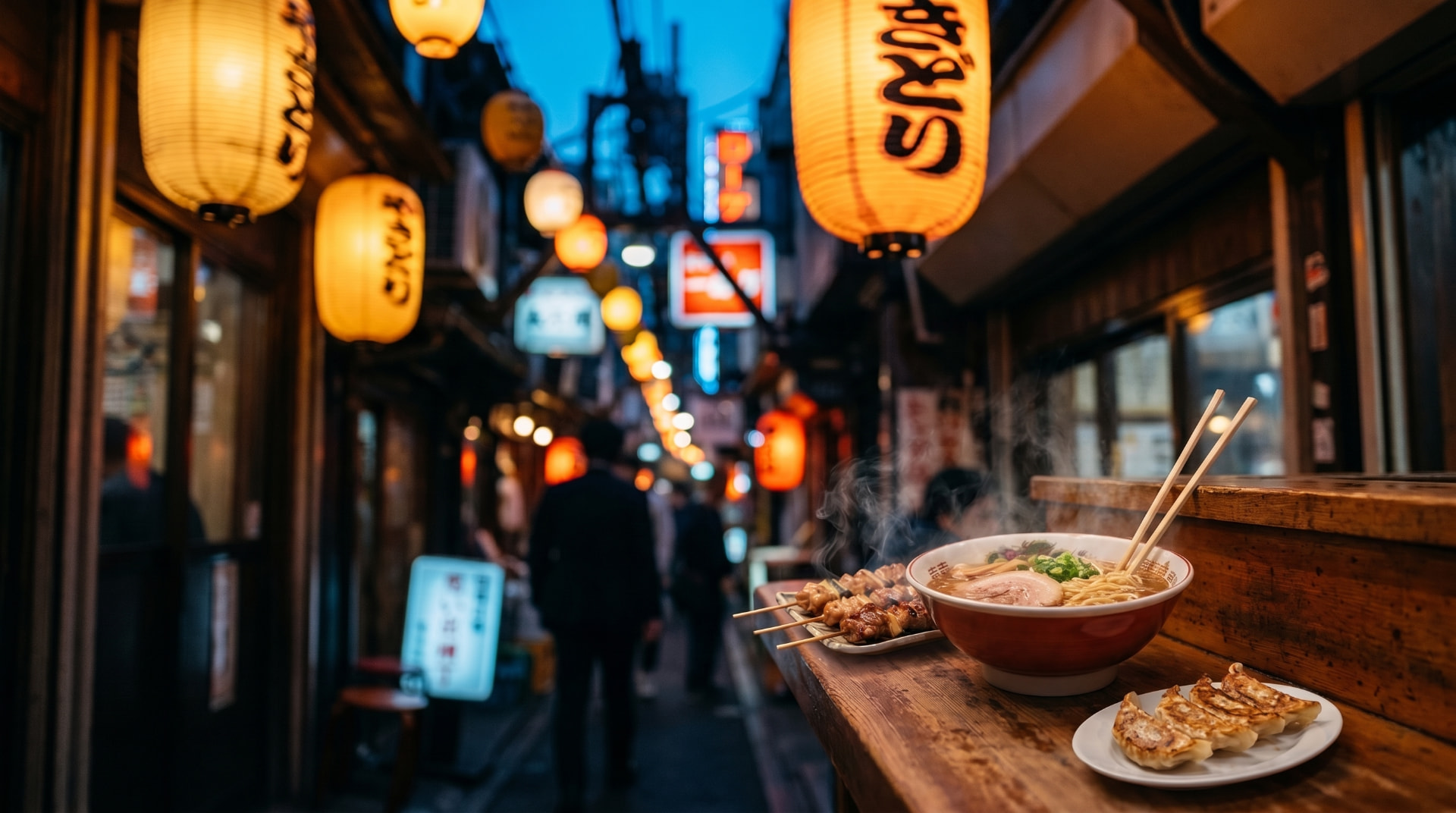
There are cities you visit and cities that change you. Tokyo is the second kind. It is simultaneously the most ordered and the most overwhelming place on earth — a city of 14 million people where trains run to the second, where a ramen shop might have a single item on the menu and a two-hour queue, and where the convenience store breakfast is, without exaggeration, better than the best café in most major cities. Tokyo does not do anything casually. That includes the food.
This is the city with more Michelin stars than anywhere else on earth. But the statistic does not tell you what it feels like to sit at a nine-seat counter at 7am eating tuna that was swimming twelve hours ago. It does not tell you about the ramen master who has made the same recipe for forty years and considers himself still in the learning phase. Or the 800-yen yakitori stall in a narrow alley under the train tracks in Shinjuku that is, quietly, one of the best meals you will eat in your life.
Tokyo is not just a food destination. It is an education in what cooking, precision, and hospitality can be at their very highest. And almost everything it does brilliantly can be brought home to your own kitchen — with the right technique, the right ratios, and the right understanding of why Japanese cooking works the way it does.
Tokyo — The Essentials
Tokyo sits on the eastern coast of Honshu, Japan's main island, and is the world's most populous metropolitan area. It is divided into distinct neighborhoods, each with its own character, food culture, and reason to visit.
The six essential neighborhoods for a first visit are Shinjuku (the transit hub and all-rounder), Shibuya (youth culture and the famous crossing), Asakusa (temples and traditional Tokyo), Harajuku (fashion and the Meiji Shrine), Ginza (luxury dining and upscale shopping), and Akihabara (electronics and pop culture). Most visitors can cover the essential six in three to four days.
For first-time visitors, Shinjuku is the stronger operational base — better transport connections, easier routing for day trips, and the widest range of hotel options. Shibuya suits those who want their evenings to be easier and more spontaneous, with walkable food, nightlife, and west-side Tokyo culture on the doorstep. Asakusa is the pick for anyone who wants older, quieter Tokyo — narrower streets, cheaper prices, and the sense that the city has not entirely been rebuilt since the Edo period.
Tokyo's rail system makes the whole city navigable. The Yamanote Line loops around the central city core in roughly 60 minutes, with most major districts sitting directly on the loop. A 24-hour Tokyo Metro pass costs 800 yen and covers connections to most neighborhoods beyond it.
The best time to visit is late March to early May for cherry blossom season — extraordinary but extremely busy — or October and November for clear skies, cooler temperatures, and the full autumn color of the city's parks and temple gardens. Both seasons reward planning ahead. Hotel prices rise sharply during sakura season and booking three to four months out is strongly advised.
The Food Culture of Tokyo
Japanese food has been recognized by UNESCO as Intangible Cultural Heritage — joining French gastronomy and Mexican cuisine on the list of the world's most culturally significant food traditions. The official UNESCO term is washoku, which translates as "the harmony of food" and refers to the deep principles of balance, seasonality, and aesthetic presentation that run through every dish on the Japanese table.
What this means in practice is that even the simplest meal in Tokyo carries weight. A bowl of ramen is not just noodles in broth — it is a calculation of fat, acid, salt, and heat refined over decades. A piece of nigiri is not just fish on rice — it is a precise ratio of seasoned rice to fish, served at a precise temperature, with the exact amount of wasabi the chef has decided that particular fish requires. Nothing here is approximate.
The city eats at every price point with equal seriousness. Not all famous Tokyo food is expensive. Street food, market stalls, standing soba counters, and station ramen shops deliver extraordinary quality at prices that feel almost impossible by Western standards. A bowl of ramen that took twelve hours to make costs eight dollars. A Michelin-starred lunch omakase costs eighty. Both are worth experiencing. Neither will disappoint.
The Soul of the City — Umami and the Art of the Dashi
If the Amalfi Coast is defined by its lemons, Tokyo is defined by dashi — the foundational stock of Japanese cooking made from kombu (dried kelp) and katsuobushi (dried, fermented, smoked skipjack tuna flakes). It is the reason Japanese food tastes the way it does. The clean, deep, savory quality that runs through miso soup, ramen broth, noodle dipping sauces and braised vegetables is not magic. It is dashi, made correctly.
Dashi is also one of the most reproducible elements of Japanese cooking at home — and one of the most transformative. Making it properly requires nothing more than kombu, good-quality dried bonito flakes, cold water, and attention to temperature. Do not boil it. Do not rush it. Weight your ingredients precisely, control your heat, and what comes out of the pot will change how you cook Japanese food forever.
The Dishes You Need to Know
Tokyo's food culture is vast, but these are the dishes that define the city — the ones you must understand before you go and attempt to recreate when you come home.
Omakase Sushi
The word omakase means "I leave it to you." At a sushi counter, it means you sit down, hand control entirely to the chef, and eat whatever they consider best that day — whatever arrived at Tsukiji that morning, whatever fish is in peak season, whatever the chef wants you to experience. A visit to Tsukiji Outer Market is one of the best ways to experience Tokyo's seafood culture — tuna, scallops, salmon, tamagoyaki and fresh sushi prepared in front of you, ideally before 8am when the best pieces are still available. The omakase counter experience ranges from 3,000 yen at a neighborhood spot to 50,000 yen at the top of the city's sushi hierarchy. Both are worth doing, for completely different reasons.
Ramen
Tokyo is a paradise for noodle lovers, with thousands of ramen shops serving distinct regional broths — shoyu (soy), shio (salt), miso, and tonkotsu (pork bone). Famous shops like Ichiran offer solo dining in private booths, while others have earned Michelin recognition for their complex, long-cooked broths. Tonkotsu is the most labor-intensive — pork bones cooked at a rolling boil for twelve or more hours until the broth turns white, opaque and extraordinarily rich. The bowl that arrives in front of you contains more time and precision than almost any other dish in the world.
Kaiseki
Kaiseki is Japan's haute cuisine, originating in 16th century Kyoto with the culture of the imperial tea ceremony. A typical meal includes twelve to twenty small dishes, each chosen for seasonal ingredients, presentation, and balance. Eaten at high-end ryokan inns or specialized restaurants, expect two to three hours per meal. It is the most complete expression of Japanese food philosophy — every dish a calculation of color, texture, temperature, and flavor that changes entirely with the season. No two kaiseki meals are the same.
Tamagoyaki
The Japanese rolled omelette is deceptively simple and, when made properly, completely captivating. Layers of thinly cooked egg are rolled in a rectangular tamagoyaki pan — each layer added before the previous one is fully set, building up a soft, slightly sweet, multilayered result with a gentle golden exterior. It is one of the most technique-dependent dishes in Japanese cooking and one of the most rewarding to master at home. Weight your eggs, season precisely, and control your heat. The difference between tamagoyaki made casually and tamagoyaki made with attention is significant.
Tempura
Tempura is a perfect reflection of Japanese perfectionism — a deceptively simple dish of battered and fried seafood and vegetables that becomes an art form when it achieves a light, crisp, and entirely non-greasy texture. You can experience its entire spectrum in Tokyo, from century-old institutions in Shinjuku to modern interpretations in Minami Aoyama. The batter is cold water and flour mixed as briefly as possible — lumps are not a problem, overmixing is. The oil temperature is everything. The result, when correct, is almost weightless.
Wagyu Yakiniku
Wagyu is Japanese beef from four specific cattle breeds, with marbled fat that melts at body temperature. The most celebrated brands are Kobe beef, Matsusaka beef, Hida beef, and Yonezawa beef. Quality is graded A1 to A5, with A5 being the highest. Yakiniku — grilling thin slices of this beef over charcoal or a tabletop grill — is the correct context in which to eat it. The fat renders in seconds. You eat immediately. It is one of the most purely pleasurable things a kitchen can produce.
The Cookware of Japanese Cooking
Japanese cooking rewards the right tools more than almost any other cuisine, but the list is shorter than you might expect.
A tamagoyaki pan — the small rectangular omelette pan — is genuinely essential if you want to make the dish correctly. A standard round pan cannot produce the same result. A good Japanese chef's knife, specifically a gyuto or santoku, transforms the precision of your prep work in a way that no Western knife quite replicates. And a digital kitchen scale is non-negotiable: Japanese recipes are built on weight ratios, not volume measures, and the difference a precise dashi or a correctly weighted ramen broth makes to the final dish is not subtle.
For ramen at home, a heavy-based stockpot that holds at least six liters gives the broth the volume it needs to develop properly. Do not attempt tonkotsu in anything smaller.
Visiting Tokyo — Practical Notes
Tokyo rewards travelers who move slowly and eat constantly. A week is a reasonable minimum — two weeks is better for anyone who wants to explore beyond the central districts to the quieter neighborhood restaurants and market streets that locals actually use.
Tokyo's neighborhoods are extremely walkable internally, but the distances between them require trains. Budget 15 to 40 minutes of transit time between non-adjacent areas. The rail system is the best in the world — clean, punctual and affordable, with a single ride costing ¥170 to ¥320.
For food, the single most useful rule is to follow the queues. A queue outside a ramen shop at 11am, a sushi counter with a two-week wait for reservations, a tempura restaurant that has been in the same family for four generations — these are the signals that matter. Tokyo has no bad food, but it has an enormous range of quality, and the locals are unfailingly accurate guides to where the best of it is.
Eat at the market early. Tsukiji Outer Market still runs and is still excellent — arrive by 7am for the best selection, especially for breakfast sushi. Eat late in the standing ramen bars under the train tracks in Shinjuku. Eat everything in between.
Tamagoyaki — The Japanese Rolled Omelette
Tamagoyaki is the perfect starting point for bringing Tokyo's food culture into your own kitchen. It requires no specialist ingredients, just eggs, a little mirin, soy sauce and sugar — and the technique that makes the difference between a flat omelette and something genuinely beautiful. We have developed a gram-precise recipe with step-by-step instructions and a built-in scaling tool so you can make it for one or for a whole table. Master the roll and you will understand exactly why Japanese cooking is what it is.
View the full recipe