Ceramic vs. Induction Stovetop: What's the Difference?
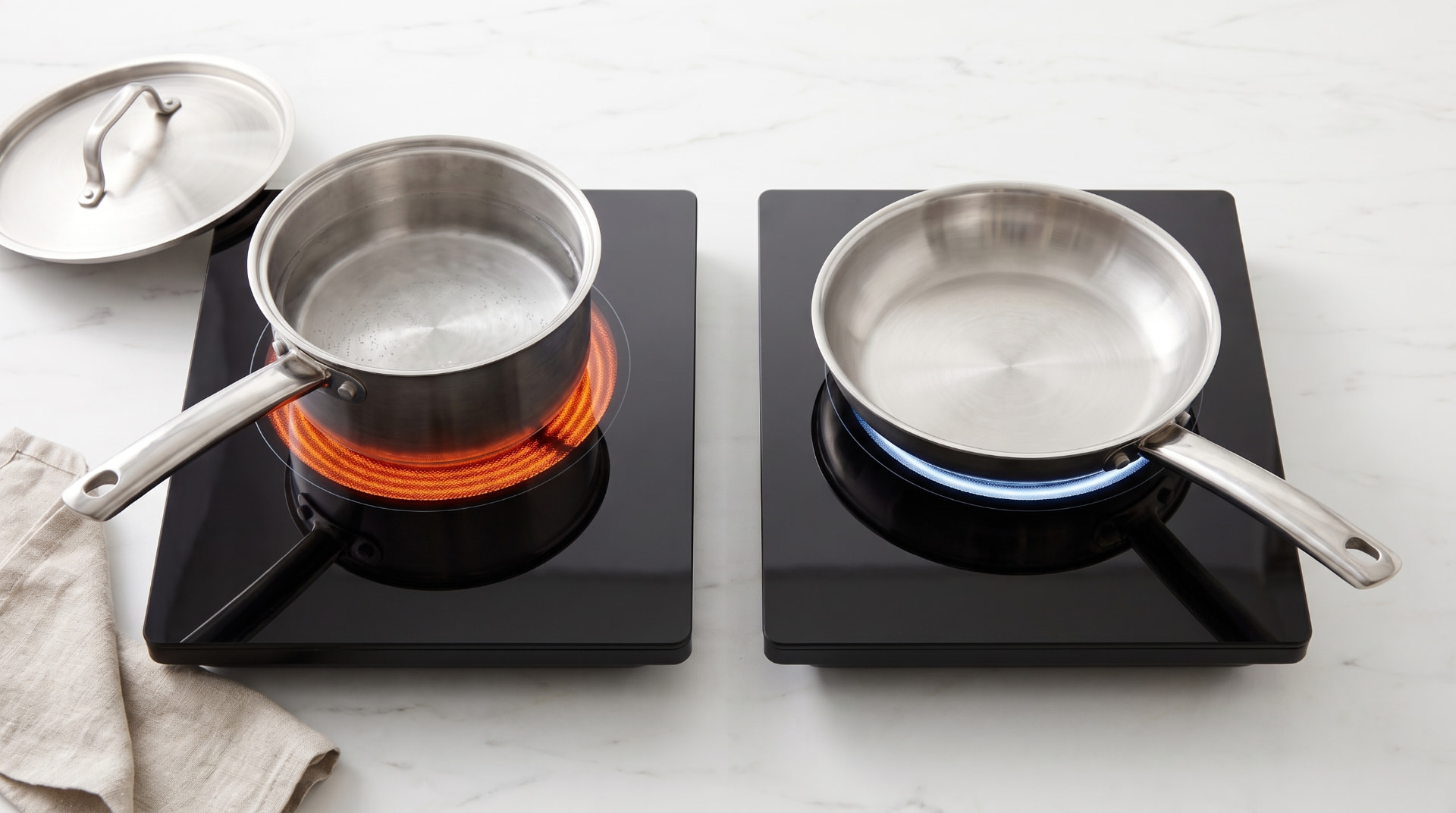
Ceramic and induction cooktops look nearly identical from the outside. Both feature a smooth glass surface with no exposed coils or burners, but they generate heat in completely different ways. That difference affects which cookware you can use, how fast your food cooks, how much energy you use, and how safe the surface is while cooking. Here's how they compare.
Ceramic vs. Induction at a Glance
| Feature | Ceramic Cooktop | Induction Cooktop |
|---|---|---|
| How it heats | Electric coil under a glass surface heats the glass, which heats the pan | Electromagnetic field heats the pan directly through magnetic induction |
| Cookware needed | Any flat-bottomed cookware | Only ferromagnetic cookware (cast iron, carbon steel, magnetic stainless) |
| Heating speed | Slower, since heat transfers through the glass first | Very fast, since the pan itself becomes the heat source |
| Energy efficiency | About 70 to 75 percent efficient | About 85 to 90 percent efficient |
| Surface temperature while cooking | Very hot, since the glass is what heats the pan | Stays relatively cool, only warmed by the pan sitting on it |
| Auto shutoff | Available on many models | Standard on nearly all models when no pan is detected |
| Typical upfront cost | Lower | Higher |
How Ceramic Cooktops Work
A ceramic cooktop uses electric heating coils installed underneath a smooth glass ceramic surface. When you turn on a burner, the coil heats up, warms the glass above it, and the glass transfers that heat to your pan. It works with any flat-bottomed cookware, so a standard tri-ply stainless steel frying pan works well as long as the base sits flush against the surface.
How Induction Cooktops Work
Induction cooktops use an electromagnetic field generated by a copper coil beneath the glass surface. That field creates heat directly inside the pan itself through magnetic induction, so the cooktop surface stays relatively cool. There is no burner heating the pan from below, the pan is the burner. This is why induction only works with cookware that has a ferromagnetic base.
Cookware Compatibility Is the Biggest Difference
Ceramic cooktops accept almost any flat-bottomed pan, including stainless steel, aluminum, copper, cast iron, and glass. Induction is more selective. It only works with ferromagnetic cookware, which means the base needs to attract a magnet. A cast iron skillet set works perfectly on both, and an induction-compatible stainless steel cookware set gives you compatibility with either cooktop. Bare aluminum, copper, and glass cookware will not heat on induction. The easiest way to test any pan is to hold a small magnet to the bottom. If it sticks firmly, it will work on induction. If you want a complete breakdown by material, use our Induction Cookware Compatibility Checker.
Speed and Energy Efficiency
Induction is significantly faster than ceramic. Because the pan itself becomes the heat source, water boils and pans preheat in a fraction of the time. Induction is also more energy efficient, transferring about 85 to 90 percent of its energy into the pan, compared to roughly 70 to 75 percent for ceramic. Less wasted heat means faster cooking and a cooler kitchen.
Safety and Cleaning
Induction is the safer of the two because the surface only heats up from residual warmth of the pan sitting on it. Remove the pan and the burner cools quickly. Ceramic cooktops, in contrast, get very hot and stay hot well after you turn them off. Both surfaces are smooth glass, so both clean up easily with a soft cloth. For stuck-on residue, a glass and ceramic cooktop cleaner kit is the standard tool. Avoid abrasive pads, which can scratch the surface.
Cost
Ceramic cooktops are generally less expensive upfront and share the same price range as standard electric ranges. Induction cooktops cost more to purchase, but they use less energy over time and often qualify for utility rebates. If you factor in long-term efficiency, the cost gap narrows.
Which One Should You Choose
Choose ceramic if you want a lower upfront cost and the flexibility to use any flat-bottomed pan you already own. Choose induction if you want faster cooking, better energy efficiency, a cooler cooking surface, and you are willing to invest in cookware with a ferromagnetic base. Both look sleek, both are easy to clean, and both are a step up from traditional coil electric ranges.
Frequently Asked Questions
Can I put an induction pan on a ceramic cooktop?
Yes. Ceramic cooktops work with any flat-bottomed cookware, including cookware made for induction.
Can I use my old ceramic cooktop cookware on induction?
Only if the base is ferromagnetic. Check with a magnet before assuming it will work.
Why does my induction cooktop not heat up when I put a pan on it?
The pan likely isn't ferromagnetic, or it isn't making full contact with the burner. Try a different pan or center it more carefully over the cooking zone.
Is induction more expensive to run than ceramic?
No, it's typically cheaper to run since it wastes less energy heating the cooktop surface itself. The higher cost with induction is usually the upfront purchase price, not ongoing energy use.
Do ceramic and induction cooktops look different?
Not from the outside. Both use a smooth glass surface with no visible coils or burners, so the difference is entirely in how they generate heat underneath.