Oxtails: Do They Really Come From an Ox?
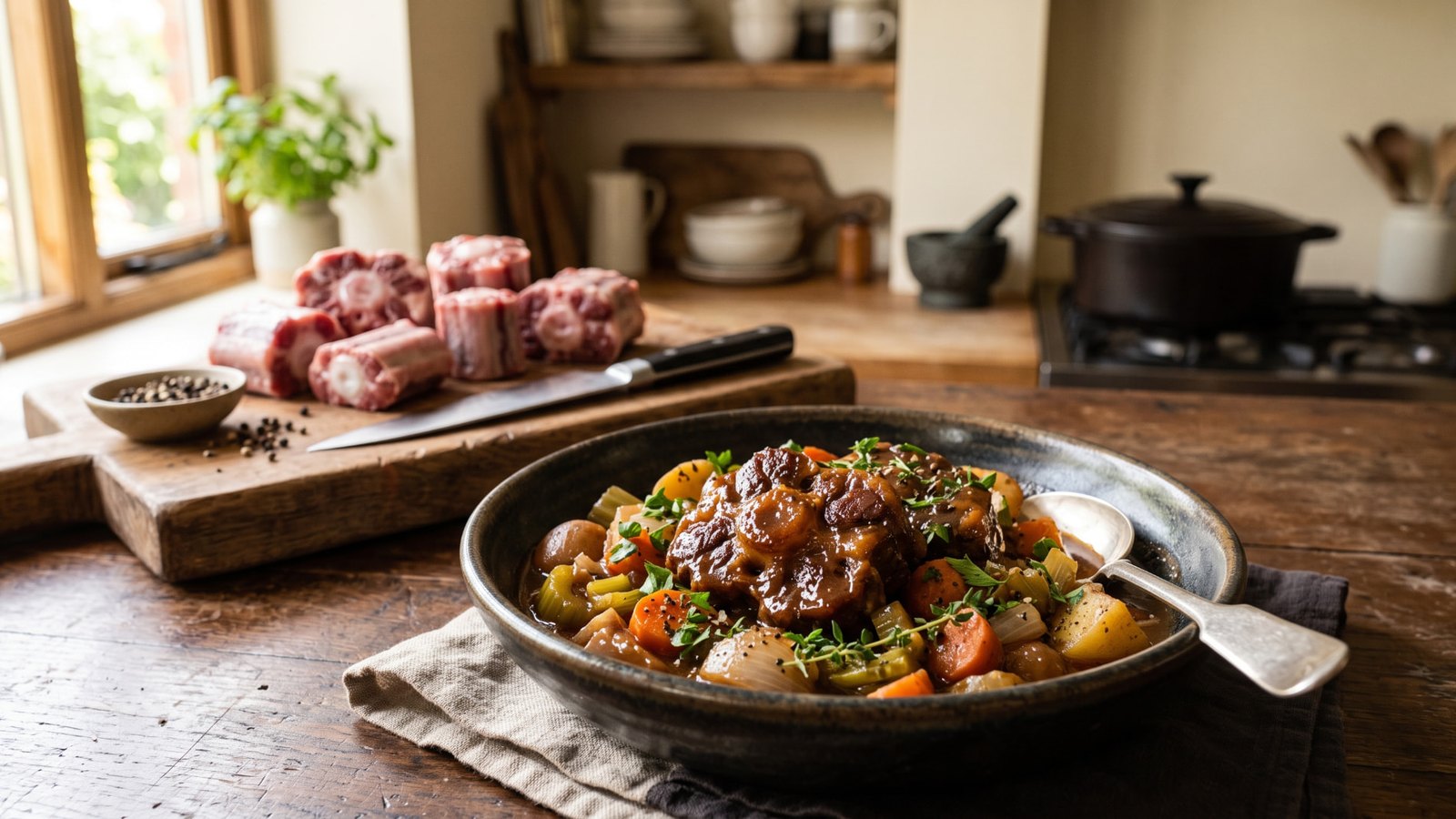
Ask ten people what oxtail is and eight of them will say "the tail of an ox" with total confidence and zero hesitation. Which is fair, since that's exactly what the name implies. It's also, historically, only half true, and the other half is a genuinely interesting bit of food history hiding inside your stew.
What Is Oxtail, Exactly?
Oxtail is the tail of cattle, cut into thick cross-section pieces sometimes called "joints." Each piece is a segment of tailbone wrapped in meat, fat, and a heavy layer of connective tissue. A whole tail runs about 3.5 kilograms (roughly 8 pounds) once it's skinned and cut down for sale, and in the US meat industry it even has its own formal classification number (NAMP 1791), which is a fancy way of saying: yes, this is a real, recognized cut, not a butcher's afterthought.
Because oxtail is mostly connective tissue and bone, it's one of the least "meaty" cuts by weight. What it lacks in yield, though, it makes up for in payoff. All that connective tissue is loaded with collagen, and collagen is what turns into rich, silky gelatin after a long, slow cook. That's the entire reason oxtails show up in soups, stews, and braises across nearly every cattle-raising culture on earth.
Does Oxtail Really Come From an Ox?
Here's the twist: it used to, and now it doesn't have to.
"Ox" traditionally referred to a castrated adult male bovine, specifically raised for labor rather than meat. In the past, oxtail meant exactly what it says: the tail of one of these animals. Today, the word has drifted into a generic culinary term. Oxtail sold at the grocery store or butcher counter comes from cattle of either sex, at whatever age is standard for beef production. There's no meaningful difference in the tail itself between a steer, a heifer, or an actual ox. The name just never got updated.
There's an even older layer to this. After the Norman Conquest of England, the country ended up with two words for a lot of animal parts: a French-derived word for the fancy cuts served to the new Anglo-Norman ruling class, and an Old English word for everything else, which was left to the people who'd been conquered. "Beef" (from the French boeuf) got the prime cuts. "Ox" and its compounds, like ox-tail and ox-cheek, got stuck with the parts nobody in charge wanted. So "oxtail" isn't really naming an animal at all anymore. It's a linguistic leftover from a class divide that's been gone for nearly a thousand years, still sitting quietly in the grocery store freezer.
Oxtail vs. Kangaroo Tail
If you've spent any time researching oxtail, you may have run into kangaroo tail comparisons, and there's a real reason for that. Kangaroo tail is prepared almost identically to oxtail: long, slow, moist cooking that breaks down thick connective tissue into a silky, gelatin-rich broth. Historical Australian bush cooking describes kangaroo tail stew and soup in nearly the same language used for classic oxtail dishes, and more than one old account claims kangaroo tail actually rivals oxtail in quality once it's properly cooked.
The two cuts aren't interchangeable in availability (oxtail is far easier to find in most US grocery stores and butcher shops), but if you're curious about the comparison: expect a similar texture payoff, a similarly long cook time, and a similarly heavy hand needed to trim off tough sinew before cooking. If you ever do come across kangaroo tail, most oxtail recipes will translate directly.
Where to Buy Oxtail
Oxtail isn't always sitting in the standard meat section, but it's usually not hard to find. Check the butcher counter first and ask directly, since it's sometimes kept in the back rather than displayed. Latin American, Caribbean, Asian, and international grocery stores tend to carry it reliably and often at a better price than a mainstream chain. If none of that is convenient, a local butcher shop or an online specialty meat retailer will almost always have it, usually frozen.
How to Cook Oxtail
Oxtail rewards patience. Whatever method you choose, the goal is the same: break down that connective tissue until the meat is fork-tender and practically falling off the bone.
- Oven: Low and slow wins here. 300°F for 6 to 8 hours covered is the most common range, though some cooks go as low as 250°F overnight for a hands-off approach. A quicker version browns the oxtail uncovered first, then finishes covered in liquid for 2 to 3 hours at a slightly higher temperature.
- Slow cooker: 8 to 10 hours on low, or 4 to 6 hours on high. Low is the better choice if you have the time. It gives the connective tissue a gentler, more even breakdown.
- Pressure cooker: If you're short on time, 45 to 50 minutes at high pressure followed by a natural release gets you most of the way to the same tenderness in a fraction of the time.
Across every method, you're cooking for texture, not a specific internal temperature. Oxtail is done when it's meltingly tender and pulling away from the bone, not at the moment it technically becomes safe to eat.
A few cuisines worth knowing:
- Jamaican oxtail stew leans on scotch bonnet pepper, curry powder, and browning sauce, a dark, slightly bitter caramelized sugar sauce that's a pantry staple across Caribbean and soul food cooking and gives the stew its deep color.
- Korean kkori-gomtang simmers oxtail into a milky, collagen-rich bone soup, seasoned simply with salt and served over rice.
- Coda alla vaccinara is a Roman braise built on oxtail, tomato, and celery, one of Rome's classic "fifth quarter" dishes built from cuts nobody else wanted.
- British oxtail soup has recipes on record dating back to at least 1845, when it was praised as an inexpensive, nutritious way to stretch a cut most kitchens had otherwise written off.
If you're building a full oxtail soup and want help scaling it for a crowd, our Soup Bar Calculator can help you figure out quantities and pairings.
FAQ
Does oxtail actually come from an ox?
Not necessarily. It used to, back when "ox" meant a castrated adult male bovine raised for labor. Today "oxtail" is a generic culinary name for the tail of any cattle, regardless of sex.
What part of the cow is oxtail?
It's literally the tail, cut crosswise into thick segments of bone surrounded by meat, fat, and connective tissue.
Why is oxtail so gelatinous?
The tail is mostly connective tissue and bone rather than muscle. Long, slow cooking breaks that connective tissue down into collagen-rich gelatin, which is what gives oxtail dishes their signature silky, rich texture.
Is oxtail the same as kangaroo tail?
No, but they're cooked almost identically. Both are gelatin-rich, connective-tissue-heavy cuts that need a long, slow, moist cook, and historically kangaroo tail has been described as a close substitute for oxtail in stews and soups.
How long does it take to cook oxtail?
Plan on 6 to 8 hours in the oven at 300°F, 8 to 10 hours on low in a slow cooker, or 45 to 50 minutes in a pressure cooker. Oxtail is done by texture, not a specific temperature, so cook until it's fork-tender.
Where can I buy oxtail?
Ask at a butcher counter, check Latin American, Caribbean, or Asian grocery stores, or order from a specialty meat retailer online. It's not always displayed, so it's worth asking directly if you don't see it.