What Is a Meat Pie? A Guide to Its Regional Variations
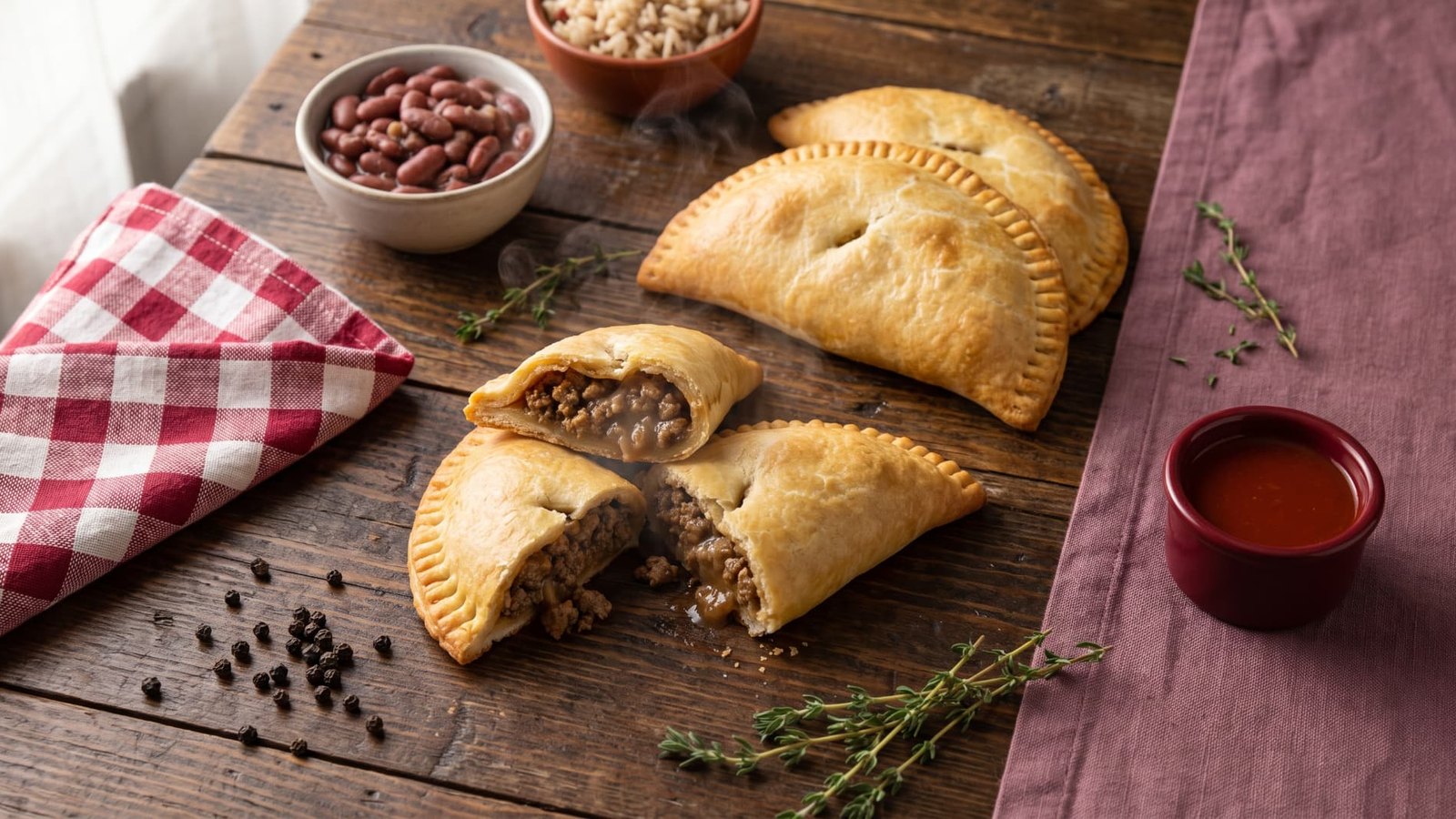
What Is a Meat Pie?
At its simplest, a meat pie is meat (sometimes with vegetables or gravy) wrapped or topped with pastry, then baked or fried until the crust turns golden. That's the whole concept. But almost every culture that's ever had access to flour, fat, and meat has built its own version of it, from ancient Egypt and Greece to Rome, and from there across nearly every continent.
What's interesting isn't the definition. It's how many different directions people took it once they had it. Some fold it into a hand-held turnover you can eat on a job site. Some spice it with cinnamon and clove and serve it at Christmas. Some fry it, some bake it, some layer it in paper-thin phyllo instead of pastry at all. We're going to walk through some of the best-known versions, one region at a time, starting with the one that means the most to us personally.
Natchitoches Meat Pies
If you've never had a Natchitoches (pronounced NACK-uh-tish) meat pie, imagine a crescent-shaped hand pie with a golden, slightly crisp crust, filled with a well-seasoned mixture of ground pork and beef in a savory gravy. They're traditionally deep-fried, though plenty of home cooks bake them too. Either way, they're the kind of food that gets handed down recipe card to recipe card rather than looked up online.
The pie takes its name from Natchitoches, Louisiana, the oldest permanent European settlement in the territory that would later become the Louisiana Purchase. Its exact origin is genuinely disputed, and honestly, that's part of the charm. One theory traces it to the empanada, introduced to the region by Spanish soldiers stationed at the nearby outpost of Los Adaes in the 1700s. Another points to French Canadian tourtière, possibly carried south by the city's French Canadian founder, Louis Juchereau de St. Denis, when he arrived in 1713. Most food historians agree the truth is probably some blend of both, plus Creole and Native American influence layered in over three centuries.
Louisiana made it official in 2003, naming the Natchitoches meat pie the state's official meat pie. The city has celebrated it every September since 2002 with the Natchitoches Meat Pie Festival, and Lasyone's Meat Pie Kitchen, open since the 1960s, has been serving them up since long before that.
English and Cornish Meat Pie
England's most iconic contribution to the meat pie world is the Cornish pasty: a hand-held pastry turnover dating back to at least the 1200s, historically carried by Cornish tin miners as a self-contained, portable meal they could eat underground without utensils.
The Cornish pasty is one of the more strictly defined meat pies out there. Since 2011, it's held Protected Geographical Indication status in the UK, meaning an authentic Cornish pasty has to be made in Cornwall, hand-crimped in the traditional fashion, and contain only beef, potato, swede (rutabaga), onion, and salt, all assembled raw before baking. No substitutions allowed if you want to call it the real thing.
Australian Meat Pie
The meat pie arrived in Australia with British settlers in the late 1700s and, at first, looked almost identical to its English counterpart: mutton or lamb wrapped in pastry. Over the next two centuries it became something else entirely. Today's Australian meat pie is typically filled with minced beef or lamb in a rich gravy, sometimes with peas or mushroom, baked in a flaky pastry shell just big enough to hold in one hand.
Former New South Wales Premier Bob Carr called it Australia's "national dish" in 2003, and the label stuck. It shows up at footy matches, corner bakeries, and school lunches alike, and it's hard to find a more universally recognized food in the country.
Canadian Tourtière
Tourtière is Quebec's answer to the meat pie: a double-crusted pie filled with ground pork, beef, or a mix, seasoned with a warm spice blend of cinnamon, clove, allspice, and nutmeg that sets it apart from nearly every other meat pie on this list. If you've seen it called "French meat pie" online, that's the same dish. Because it comes from French-speaking Quebec rather than France itself, it's often marketed that way outside Canada.
Tourtière traces back to French settlers in 1600s Quebec, though the earliest written recipe doesn't appear until 1840, in the cookbook La cuisinière canadienne. It remains a centerpiece of réveillon, the festive meal Quebecois families share after midnight mass on Christmas Eve. In the Saguenay-Lac-Saint-Jean region, you'll find a deep-dish variation packed with cubed game meat instead of the more common ground filling.
Jamaican Beef Patty
The Jamaican beef patty is a crescent-shaped pastry with a turmeric-tinted golden crust and a filling built around ground beef, Scotch bonnet pepper, allspice, thyme, and curry powder. Most food historians trace its roots to the Cornish pasty, brought to Jamaica by British ships during 17th-century colonial trade routes. From there, African, Indian, and Chinese culinary influences on the island reshaped it into something distinctly Jamaican.
The beef patty has traveled well beyond Jamaica. Jamaican immigrants introduced it to cities like New York, Toronto, and London in the mid-1900s, and today it's just as easy to find a patty shop in Brooklyn as it is in Kingston. Beyond beef, you'll also find chicken, vegetable, and even ackee-filled versions.
Greek Kreatopita
Kreatopita translates literally to "meat pie" in Greek, and it's less a single recipe than a whole family of regional traditions. In Epirus, in northern Greece, it's often bulked up with leeks or wild greens. On the island of Cephalonia, the classic version uses three different ground meats along with rice and tomato. Depending on where you are, the pastry might be delicate, buttery phyllo or a heartier oil-based shortcrust, and the filling is often warmed with cinnamon or nutmeg.
What ties all the versions together isn't a fixed ingredient list. It's the idea that every village, and often every household, has its own take.
Nigerian Meat Pie
The Nigerian meat pie has its roots in British colonization. British traders and colonial officials opened bakeries in Lagos in the late 1800s, and the earliest versions were simple pasties filled with minced beef and potatoes, not far off from a Cornish pasty. Nigerian cooks transformed it from there, adding Scotch bonnet peppers, curry powder, and thyme, and eventually shifting it from colonial-oven baking to the deep-fried, street-vendor version that's now a fixture of Nigerian snack culture.
Today it's a staple at parties, weddings, and gatherings of every kind across Nigeria, typically filled with seasoned ground beef, potatoes, carrots, and sometimes green peas. If you're planning a spread of your own, our Party Food Calculator can help you figure out how many pies or other bites you'll need per guest.
A Few More Worth Knowing
Egyptian meat pie. Savory pastries filled with spiced ground meat show up throughout Egyptian and broader North African cooking, often flavored with cumin, coriander, and warm baking spices, and typically baked rather than fried.
Indian meat pie. India doesn't have one single "meat pie," but spiced meat-filled pastries are everywhere in Indian cuisine, from the fried, dough-wrapped keema samosa to British-Indian bakery hybrids like the mutton puff, a flaky pastry filled with spiced minced meat that grew out of colonial-era baking traditions.
The Thread That Connects Them
Look closely at this list and a pattern shows up again and again. The Cornish pasty helped shape the Jamaican patty and the Nigerian meat pie. Louisiana's own Natchitoches pie may owe a debt to a Spanish empanada or a French Canadian tourtière, or both. Meat pies are, more than almost any other dish, a food that travels: carried by miners, colonizers, settlers, and immigrants, then reshaped by whoever picked it up next with whatever spices and meats they had on hand.
FAQ
What is a meat pie?
A meat pie is a dish made of meat, often with vegetables or gravy, enclosed in or topped with pastry, then baked or fried. Nearly every culture has its own version.
What's the most famous meat pie?
The Australian meat pie is probably the most globally recognized, thanks to its status as Australia's unofficial national dish, but the Cornish pasty, Jamaican beef patty, and Canadian tourtière are all internationally known in their own right.
Are meat pies baked or fried?
Both. Australian, English, and Canadian meat pies are typically baked, while Natchitoches meat pies and Nigerian meat pies are traditionally deep-fried, though baked versions of each exist too.
Can meat pies be frozen?
Yes, most meat pies freeze well, both before and after baking. For the best texture, let baked pies cool completely before freezing, and reheat from frozen in the oven rather than the microwave to keep the crust crisp.