What Is Basting? Does It Actually Work?
As an Amazon Associate, I earn from qualifying purchases.
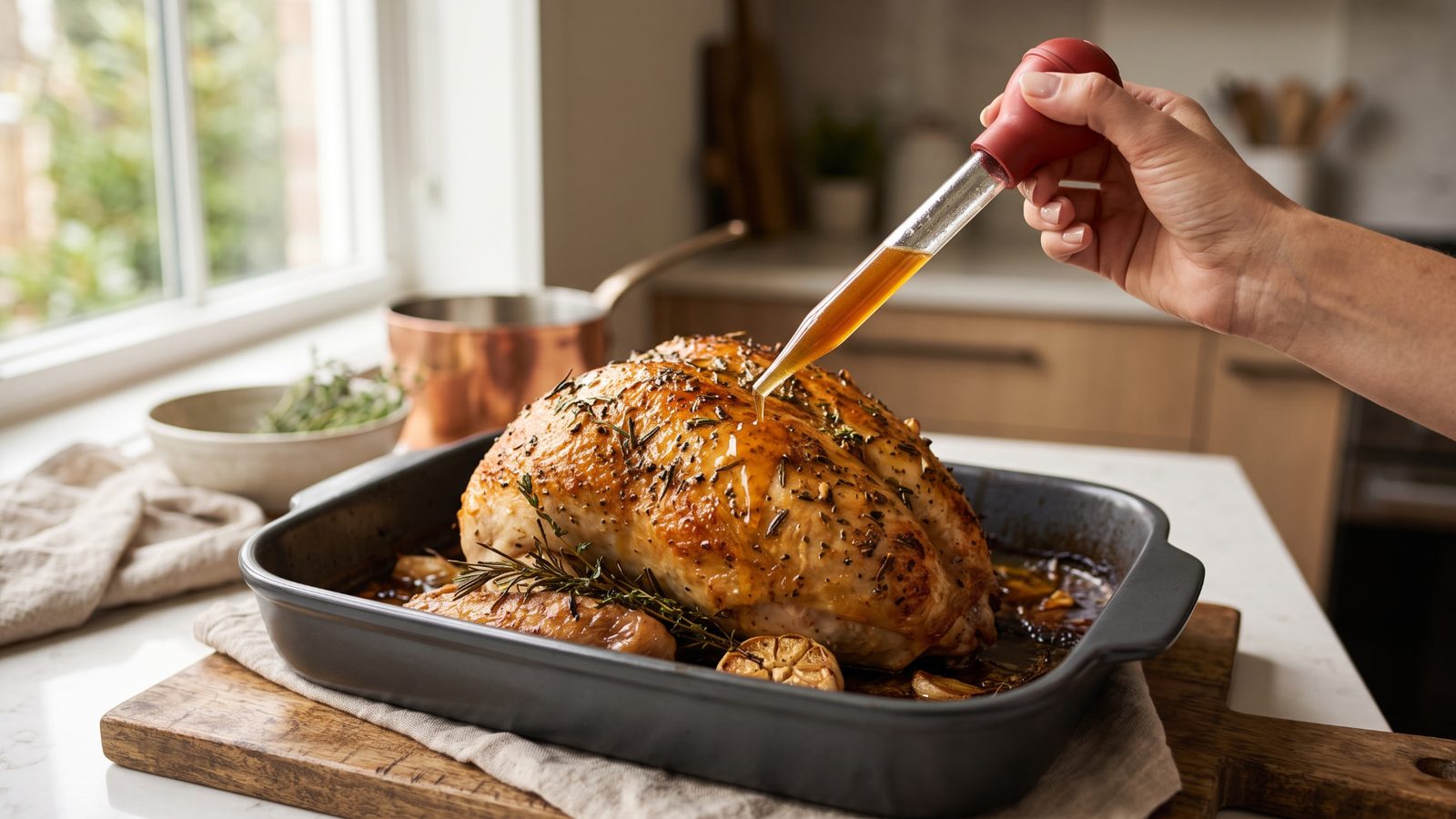
Every Thanksgiving, someone stands at the oven every twenty minutes, spoon in hand, convinced they're the only thing standing between a juicy bird and a dry one. Meanwhile, a growing chorus of food scientists is out here saying that spoon might be doing more harm than good. So what is basting, does it actually work, and is it worth the trip back and forth to the oven? Let's find out.
(Quick note before we go further: if you searched "basting" hoping to learn a sewing stitch, this is not that page. You want a fabric and thread situation, not a turkey.)
What Does Basting Mean?
Basting is spooning, brushing, or pouring liquid or fat over food while it cooks. The goal is usually one or more of three things: keeping the surface moist, adding flavor, and helping the outside brown.
There are three basic types of basting liquid:
- Pan drippings or stock. The juices a roast releases as it cooks, sometimes stretched with broth or wine.
- Fat. Melted butter, oil, or rendered animal fat, usually the go-to for flavor and browning.
- Self-basting. The food's own juices, redistributed rather than added to. This is what happens naturally inside a covered roast or an oven bag.
Does Basting Actually Work?
This is the part most basting guides skip, and it's the part worth reading closely.
Turkey: Not really
A rigorous side-by-side test was conducted on three roasted turkey breasts at once: one left completely alone, one basted every 20 minutes, and one where the oven door was simply opened and closed every 20 minutes without any basting, just to isolate the effect of the door itself.
The basted turkey came out slightly more browned. That's it. Moisture loss was nearly identical across all three. Worse, basting extended the total cooking time, because every time the oven door opens, the temperature drops (by roughly 25°F within seconds), and the oven has to work to recover. More time in the oven means more time for the meat to dry out, which cancels out whatever moisture basting was supposed to add in the first place.
The reason basting doesn't move the needle on a whole turkey comes down to penetration. Liquid brushed onto the surface of a large roast doesn't make it into the meat. It sits on top, and a lot of it just runs off into the pan. Brining or salting ahead of time works because salt actually draws moisture into the muscle. Basting, by contrast, is a surface-only treatment on a roast that's mostly interior.
Steak: Again, not really
This one's more surprising, because butter basting a steak is treated as gospel in most culinary circles. But when a food scientist put the technique to a controlled test, weighing steaks before and after cooking and tracking surface and core temperature with wireless probes, the results didn't back up the hype.
Basting didn't make the steak cook faster. It didn't make it juicier. And when the basted steak was compared to one simply brushed with herbed butter after cooking, tasters couldn't tell the difference in flavor. The one genuine benefit that surfaced: a basted steak holds its heat a little better once it's plated, which matters if you're trying to serve it hot.
So why does butter basting still feel like it works? Probably some combination of the sizzle, the aroma, and the visual of glossy, caramelized meat. It looks and smells like more is happening than actually is. That doesn't mean you should stop doing it. It's still a genuinely great way to build a crust and infuse a steak with browned butter flavor. It just isn't doing the moisture-saving job people credit it with.
The takeaway
Basting, on both a 15-pound turkey and a 1.5-inch ribeye, turns out to be more about flavor, color, and a little theater than it is about locking in moisture. If you enjoy the ritual, keep doing it. If you'd rather skip it, your food probably won't suffer for it.
Want the self-basting effect without the oven trips? An oven roasting bag does this automatically. Sealing the turkey in a bag traps steam, so the bird bastes itself in its own juices the entire time it cooks. It's a solid option if you like the idea of basting but not the babysitting.
Tools for Basting
Different tools suit different jobs:
- Bulb baster (turkey baster). Great for collecting drippings pooled in tight corners of a roasting pan. Strong on collection, weaker on even coverage, and one of the harder tools to clean thoroughly.
- Basting brush. Best for even, controlled coverage, especially on delicate surfaces like fish or pastry. Silicone brushes are dishwasher-safe and don't shed bristles the way natural-bristle ones can.
- Spoon or ladle. The classic choice for scooping and pouring, especially useful for thick or chunky basting liquid that a brush or baster can't handle well.
- BBQ mop. A larger, absorbent applicator built for covering a lot of surface area fast, common with barbecue and thin vinegar- or beer-based mops.
- Flavor injector. Technically a different technique. An injector pushes liquid directly into the meat rather than onto the surface, which is actually closer to what basting is trying (and mostly failing) to do from the outside.
- Basting dome (griddle cover). A stainless steel dome you set over food on a flat-top griddle to trap heat and steam, most often used to melt cheese on smash burgers or steam vegetables alongside other food. It's become a popular Blackstone-style griddle accessory and technically creates a self-basting effect through captured steam.
How to Baste by Food Type
Turkey
If you choose to continue basting, timing matters more than frequency. Wait until after the first hour of roasting before you start. Basting too early keeps the skin wet while it's supposed to be setting and drying out, which works against getting it crisp later. Once that first hour is up, baste every 30 to 45 minutes. Basting more often than that (every 15 minutes or less) opens the oven so frequently that it meaningfully slows down cooking. Use our Turkey Calculator to get your total roast time before you plan your basting schedule around it.
Steak (butter basting)
Sear the steak first to build a crust. Once you flip it, add a generous knob of butter along with aromatics like garlic and rosemary or thyme. Tilt the pan slightly so the butter pools, then continuously spoon it over the steak as it finishes cooking, aiming for an internal temperature around 120 to 125°F before you pull it off the heat (it will climb a bit more as it rests).
One detail that trips people up: adding soft butter all at once tends to make it break and spatter, and it can burn before the steak is done. Adding it in smaller pieces, or starting with cold butter, gives you more control over browning it evenly.
Chicken and BBQ Sauce
If you're grilling chicken with a sugary barbecue sauce, timing is everything. Sugar starts to burn around 350°F, so sauce brushed on too early will scorch before the chicken finishes cooking, sometimes charring on the outside while the inside is still underdone. Hold off and apply sauce during the last 10 to 15 minutes of grilling instead, so it has just enough time to caramelize without burning.
Eggs
This is the one place basting's reputation is fully earned. Spooning hot oil or butter over a sunny-side-up egg while it cooks sets the top of the white and edges of the yolk without flipping. It works well here because an egg is thin, cooks in a couple of minutes, and the fat is in direct, constant contact with the food the entire time, none of the size or penetration problems that hold basting back on a turkey.
Basting Food Safety
If your basting liquid is a marinade or sauce that touched raw meat or poultry at any point, treat it carefully. According to the USDA, you have two safe options:
- Reserve a portion before it touches raw food. Set some marinade aside for basting before you ever add the raw meat to the rest of it.
- Boil it first. If a marinade or liquid has already touched raw meat and you want to reuse it, bring it to a full boil for at least one minute to kill off any bacteria before basting with it.
Also, don't use the same basting brush on raw and cooked food without washing it in between. A brush that dipped into raw poultry juice and then touched food that's nearly done can undo all your cooking-temperature safety in one swipe.
FAQ
What's the difference between basting and marinating?
Marinating happens before cooking, soaking food in a seasoned liquid to add flavor and, with acidic marinades, some tenderizing. Basting happens during cooking, applying liquid or fat to the surface as it's actively heating.
What's the best liquid to baste with?
It depends on the food. Pan drippings or broth work well for roasts, melted butter is the standard for steak and poultry skin, and thinner liquids like vinegar-based mops suit barbecue. Fat-based liquids brown better than watery ones, since fat and protein encourage the Maillard reaction.
Does basting make skin crispier?
No, and it can actually work against it. Adding moisture to skin that's trying to dry out and crisp up slows that process down. If crispy skin is the goal, basting less (or stopping basting toward the end of cooking) tends to help more than basting often.
Can I use basting spray instead of a brush?
Commercial basting/grilling sprays exist mainly as a convenient way to apply oil evenly, functionally similar to using a brush with a neutral oil. They're a matter of preference rather than a meaningfully different technique.
Can I buy basting oil instead of making it?
Yes. Wegmans sells a popular pre-made garlic and herb basting oil in an olive oil base, or you can recreate a similar blend at home with olive oil, minced garlic, parsley, and thyme.