What Is Braising vs. Stewing, Poaching & Simmering
As an Amazon Associate, I earn from qualifying purchases.
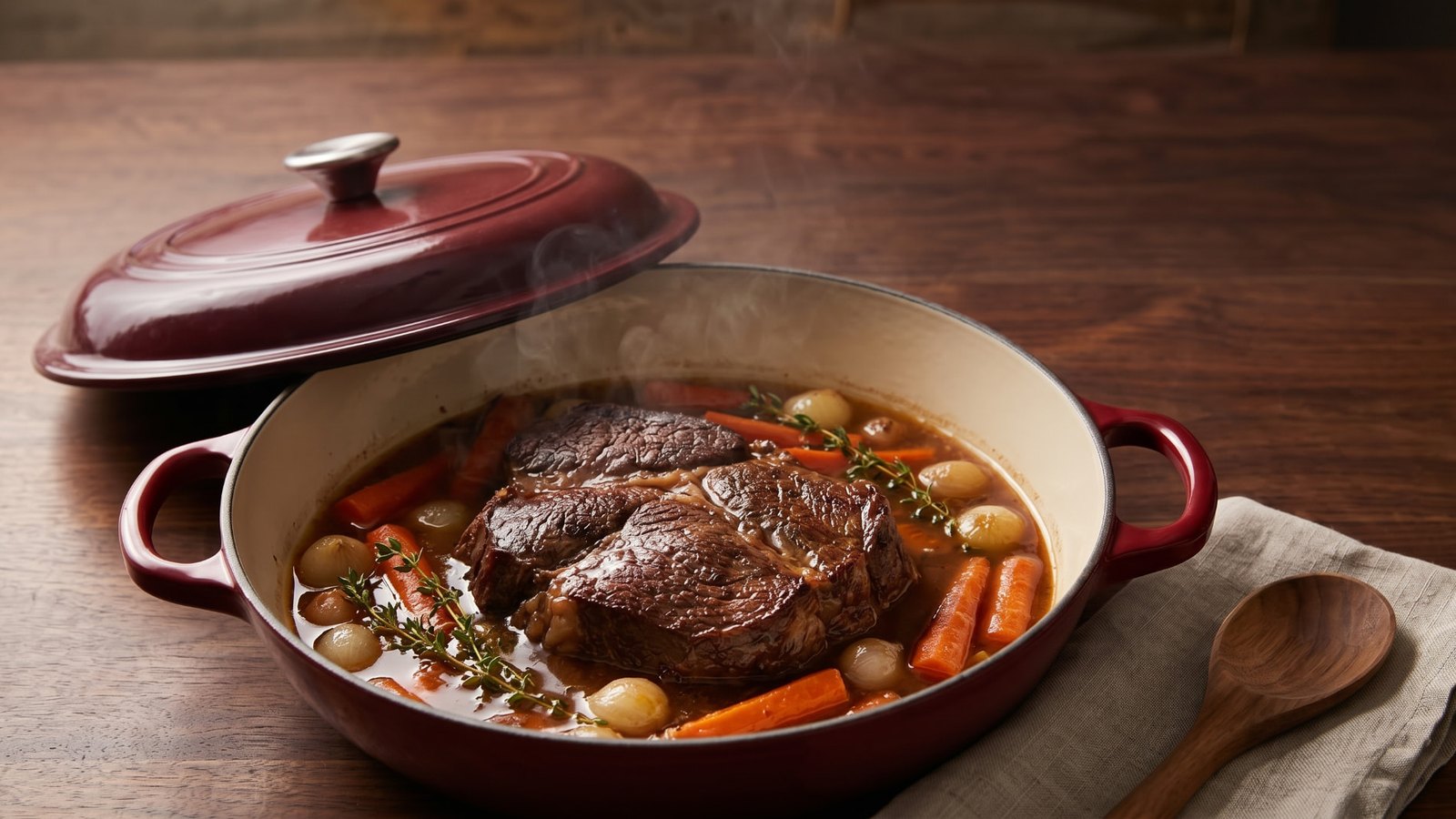
Every recipe with "moist heat" in the description sounds suspiciously like every other one, and reading five food sites in a row will convince you that braising, stewing, poaching, and simmering are just secret code for "put it in a pot." They're not. Each one asks something different of your ingredients, your liquid, and your patience, starting with the one that turns a cheap chuck roast into the best thing you'll eat all week.
What Is Braising?
Braising is a combination cooking method: sear the food at high heat to brown the surface, then transfer it to a covered pot with a small amount of liquid, enough to come about halfway to two-thirds up the food, not cover it, and cook low and slow (300-325°F in the oven, or a gentle simmer on the stovetop) until it's tender.
That low, steady heat matters because of what's happening inside the meat. Held at around 160-185°F for a long enough time, collagen, the tough connective tissue in cheap cuts, breaks down into gelatin. That's the whole trick behind braising: it takes cuts that would be tough and chewy cooked any other way and turns them silky. It's also why lean, tender cuts like chicken breast or beef tenderloin are the wrong choice for braising. They don't have enough collagen to convert, so hours in liquid just dries them out instead of tenderizing them.
Braising vs. Stewing vs. Poaching vs. Simmering vs. Steaming
All five get used interchangeably in recipes, but they differ in temperature, how much liquid touches the food, and what size the food is cut into.
| Method | Temperature | Liquid | Food Size |
|---|---|---|---|
| Braising | 300-325°F oven, or a gentle stovetop simmer | Comes about halfway to two-thirds up the food | Whole or large cuts |
| Stewing | 180-205°F simmer | Food fully submerged | Small, uniform pieces |
| Poaching | 160-190°F, barely a bubble | Food fully submerged | Delicate items: eggs, chicken breast, fish, fruit |
| Simmering | 185-205°F | Varies by dish | Not protein-specific; used for soups, sauces, grains |
| Steaming | Around 212°F steam | No direct contact with liquid | Vegetables, dumplings, fish |
Braising vs. stewing: Same low, slow logic, but stewing fully submerges smaller, uniform pieces so the meat and liquid become one dish, like a beef stew. Braising only partially submerges a larger cut; the meat stays the star, and the liquid reduces into a sauce alongside it.
Braising vs. poaching: Poaching is gentler and much faster, built for delicate foods that would fall apart under a hard sear and hours of cooking.
Where simmering fits: Simmering isn't really a competing method. It's the gentle-bubble visual cue that both braising and stewing rely on, and on its own it's used for soups, sauces, and grains rather than as a defined protein technique.
Where steaming fits: Steaming is the outlier here. No liquid ever touches the food at all, since it cooks in a steamer pot suspended above the boiling water instead.
Best Cuts for Braising
Beef: Chuck roast, short ribs, brisket, and shank all braise well at 300-325°F for 2.5 to 4 hours, until the internal temperature reaches 195-210°F depending on the cut. If brisket is the plan, our Brisket Calculator can help you work out timing based on weight.
Pork: Pork shoulder follows the same logic as beef chuck. Its higher fat content makes it a little more forgiving if the braise runs long.
Chicken: Bone-in, skin-on thighs braise at 325°F for roughly 35 to 50 minutes, until they hit about 195°F internally, well past the 165°F safety minimum. That extra time is what melts the connective tissue into something tender instead of rubbery.
What to skip: Chicken breast, beef tenderloin, and pork loin are all lean cuts with little connective tissue. Braising them just dries them out.
Braising Liquid & Equipment Basics
Good braising liquid usually starts with stock, wine, beer, or water, plus something acidic, like wine, vinegar, or tomato, to help break down connective tissue and balance the richness of the meat. Aromatics like onion, carrot, celery, garlic, and herbs round it out.
For equipment, you need a heavy pot with a tight-fitting lid that works on both the stovetop and in the oven. A Dutch oven is the standard choice. A braiser is a shorter, wider alternative that gives more surface area for searing but holds less liquid and will not fit a large roast.
FAQ
Is braising the same as slow cooking?
They're closely related but not identical. Both rely on low, moist heat, but a slow cooker can't sear, so you lose the browning step. Sear on the stovetop first and finish in the slow cooker, and you're still braising, just with different equipment.
Is a braiser the same as a Dutch oven?
Not quite. A Dutch oven has taller sides and holds more liquid, so it handles a wider range of dishes, including soups and larger roasts. A braiser is shorter and wider, which gives more surface area for searing but limits capacity, so it works best for cuts that fit in a single layer.
Can you braise something too long?
Yes. Once collagen finishes converting into gelatin, more time doesn't add more tenderness, it starts breaking down the muscle fibers themselves, which can leave meat dry, stringy, or mealy instead of fork tender. Pull it once a fork slides in easily.
Why does braised meat get cooked past its normal "done" temperature?
Standard doneness temperatures, like 165°F for chicken, are food safety minimums, not tenderness targets. Braising holds meat well above that, often 195°F or higher, long enough for tough connective tissue to melt. That's what makes braised meat fall apart instead of just being safely cooked.
What's the best liquid for braising?
Stock, wine, beer, and water all work. The best braising liquids usually include something acidic, plus aromatics like onion, carrot, celery, and garlic for flavor.
Can you braise on the stovetop instead of the oven?
Yes. Oven braising gives more even heat since it surrounds the pot, but stovetop works fine if you keep the heat low enough for a gentle simmer and check the liquid level so it doesn't scorch.
What's the difference between braising and pot roasting?
Not much, and the shared word "roast" is misleading. Pot roasting isn't dry-heat roasting; it's still moist heat, still covered, still cooked in a small amount of liquid like stock or wine. The real difference is mostly about which cut and how much liquid: pot roasting typically applies to one large, whole cut of meat, like a chuck roast, while a classic braise can also mean smaller portioned pieces. Many recipes use the two terms interchangeably.