What Is Phyllo Dough? Uses, Types, and How to Store It
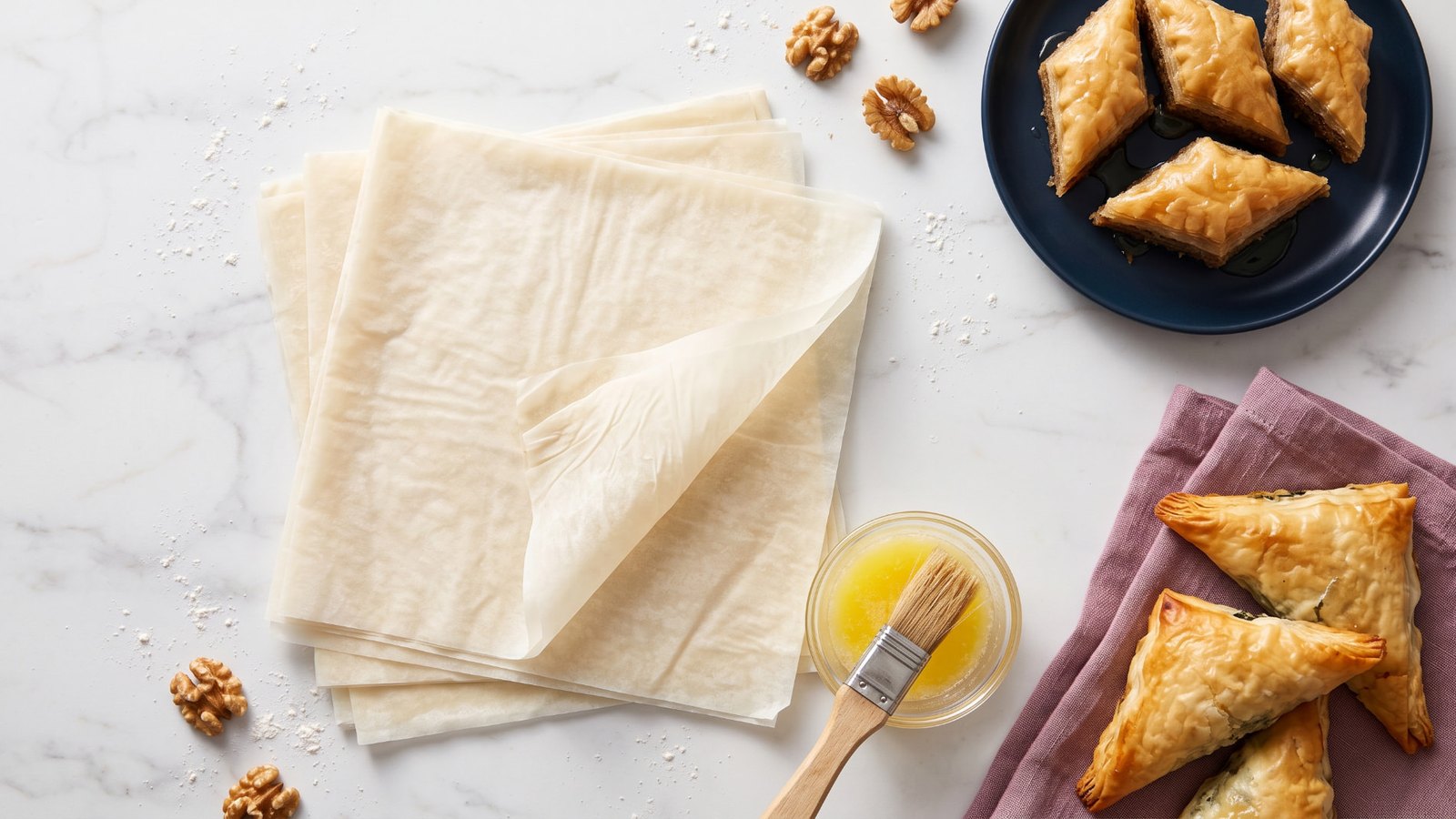
There's a box in the freezer aisle labeled "phyllo" and another one a few feet away labeled "puff pastry," and somewhere along the way most of us decided they're interchangeable enough not to ask questions. They are not interchangeable. One of them is basically origami made of flour and patience, and the other one is a butter delivery system that happens to be shaped like a rectangle. Let's sort out which is which.
What Is Phyllo Dough?
Phyllo (also spelled filo, both are correct and both show up constantly in recipes and on packaging) is a paper-thin, unleavened pastry dough made from just flour, water, a little vinegar, and a small amount of oil. The name comes from the Greek word for "leaf," which makes sense the moment you unroll a sheet: it's translucent, delicate, and about as sturdy as a fall leaf that's been sitting out for a week.
Phyllo is most associated with Greek, Turkish, and Middle Eastern cooking, where dozens of sheets get layered or brushed with fat between each one to build up a crisp, flaky texture once baked.
Phyllo vs. puff pastry: these two get lumped together constantly because the end result, a shattery, flaky pastry, looks similar. The process is completely different. Puff pastry is a laminated dough, meaning cold butter is folded into the dough and rolled out again and again, building dozens of alternating butter-and-dough layers. When it bakes, steam from that butter pushes the layers apart, and that's where the puff comes from. Phyllo has almost no fat built into the dough itself. Instead, the cook brushes melted butter or oil between individual sheets by hand as they're stacked. That's also why you can't sub one for the other in a recipe that calls for layering: puff pastry already has its fat laminated in, so stacking it the way you would phyllo just gets you a dense, greasy mess instead of crisp layers.
Types of Phyllo
Not all phyllo is the same, and if you've ever bought a box and been mystified by the number printed on it, that number is telling you the sheet thickness. Extra-thin and thin phyllo (often labeled #4 or #5) are the most delicate, best for baklava and other desserts where you want the maximum number of crisp, papery layers. Medium phyllo (#7) is a step sturdier and the standard choice for spanakopita, tiropita, and börek. Thick or "country-style" phyllo (#9 or #10) is the least delicate of the bunch but the easiest to work with, and it holds up best in hearty savory pies like meat pies and vegetable pies. Some brands also sell whole wheat phyllo as a lower-fat, higher-fiber alternative to standard phyllo. And as covered below, shredded phyllo, known as kataifi, is its own category entirely, used for kunafa and Portokalopita rather than layered sheets.
Sweet vs. Savory: What People Actually Make With It
Sweet. The single most famous phyllo dessert is baklava: layers of phyllo brushed with butter, filled with chopped nuts (usually walnuts, pistachios, or a mix), baked, and soaked in a honey or sugar syrup while it's still warm. Baklava's exact origin is genuinely disputed between Greece and Turkey, with most food historians tracing the layered, nut-and-syrup version we eat today back to the Ottoman Empire, and an even older layered dough-and-honey dessert showing up in ancient Mesopotamia. Nobody's settling that argument in a blog post, so we won't try.
Beyond baklava, phyllo shows up in apple turnovers (a quick way to fake a hand pie without making pastry dough from scratch) and in Portokalopita, a Greek orange phyllo cake made by tearing sheets into shreds, mixing them into an orange-vanilla custard batter, and soaking the baked cake in orange syrup. It's less delicate work than baklava and a good starting project if you've never touched phyllo before.
Savory. Spanakopita (spinach and feta wrapped in phyllo) and tiropita (the cheese-only version, no spinach) are the two most common Greek phyllo pies, usually shaped into triangles or rolled into a spiral and sliced. Börek is the broader term used across Turkish and Balkan cooking for savory phyllo pastries in general, filled with spinach and cheese, ground meat, or potato, and there's real overlap in how "spanakopita" and "börek" get used depending on who's naming the dish. Phyllo also turns up in chicken pot pie and other meat pies as a lighter, crisper alternative to a traditional pie crust, and in phyllo cups, the little pre-baked shells you fill with anything from spinach dip to fruit and mascarpone for a party tray. If you're using phyllo cups or a phyllo-topped pie for a gathering, our Party Food Calculator is a natural next stop for figuring out how much to make.
Regional Names Worth Knowing
Two more phyllo desserts come up often enough to name specifically. Kunafa (also spelled knafeh) is a Middle Eastern dessert, associated with the city of Nablus, made with shredded phyllo, called kataifi, rather than sheets. It's traditionally layered with a soft cheese filling and soaked in a rose-water syrup, served warm. Portokalopita, mentioned above, uses that same shredded phyllo technique in a completely different direction, orange custard cake instead of cheese pastry. If a recipe calls for kataifi, it's still phyllo, just torn or shredded rather than laid flat.
Working With Phyllo Without Losing Your Mind
Phyllo has a reputation for being fussy, and that reputation is earned, but it comes down to one issue: it dries out fast. A few things make it manageable:
- Thaw it slowly. Overnight in the fridge is the safest bet. Countertop thawing works in a few hours if you're in a hurry, but it needs more attention, and the microwave should only be a last resort since it's easy to toughen or dry out the dough.
- Keep it covered. Once you unroll it, drape a damp towel over the sheets you're not actively using. Phyllo left uncovered for even a few minutes can start cracking.
- Work quickly and brush the edges first. Starting your butter or oil at the edges and working in helps prevent the corners from drying and splitting before the rest of the sheet is brushed.
- Storage: unopened phyllo keeps in the fridge for several weeks, and once opened, leftover sheets wrapped tightly will hold for about a week in the fridge or a couple of months back in the freezer.
FAQ
Is phyllo dough gluten-free?
No. Traditional phyllo is made with wheat flour, so it contains gluten. Gluten-free versions exist, but they're mostly homemade recipes built around a gluten-free flour blend and xanthan gum rather than a common store-bought product, so don't expect to find a gluten-free box sitting next to the regular phyllo at most grocery stores.
Is phyllo dough vegan?
The dough itself usually is, since it's made with oil rather than butter. What you make with it is a different story. Butter is the traditional fat brushed between the sheets, and fillings like feta, cream cheese, egg wash, or honey are common, so a finished baklava or spanakopita is often not vegan even though the base dough could be. Always check the ingredient label on packaged phyllo and ask about the filling if you're ordering it somewhere.
How do you pronounce phyllo?
FEE-loh. The "ph" makes an F sound, same as in "philosophy," and it rhymes with the spelling "filo," which is really just the same word.
Where do you buy phyllo dough?
It's sold frozen in most major grocery stores, usually in the freezer case near the puff pastry and pie crusts. Athens is the most common national brand in the U.S.